
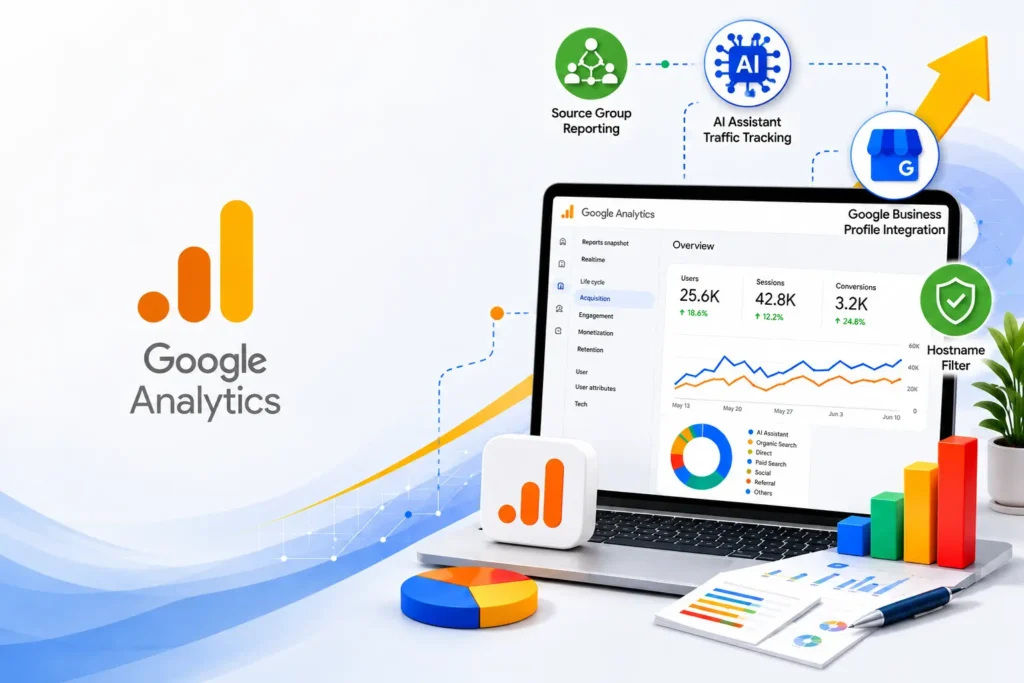
Google Analytics has rolled out several new features that could make life much easier for SEOs, digital marketers, and business owners. The latest updates focus on improving traffic source reporting, tracking AI-driven visits, measuring local business performance, and keeping analytics data cleaner and more accurate.
Together, these enhancements provide marketers with a clearer understanding of where visitors come from, how AI platforms influence website traffic, and how local business listings contribute to customer engagement.
Better Source Reporting with New Source Grouping
One of the biggest challenges in analytics reporting has always been inconsistent source names. For example, traffic from Facebook can appear under multiple variations such as “facebook”, “fb”, or other custom naming formats, making performance analysis more difficult.
To solve this issue, Google Analytics has introduced a new reporting dimension called Source Group. This feature automatically consolidates different source variations into a single standardized category, making reporting cleaner and easier to interpret.
The update also includes improvements to the existing Source Platform dimension, helping marketers better understand performance across advertising channels and third-party platforms.
With these enhancements, businesses can:
- Analyze cross-channel performance more accurately
- Simplify attribution and budget reporting
- Compare results across platforms more effectively
- Access standardized reporting for platforms such as TikTok, Pinterest, Amazon, Facebook, Instagram, and Google properties
Interestingly, Google has also included support for emerging AI-driven traffic sources such as ChatGPT and Perplexity, helping businesses prepare for the growing role of AI in content discovery and website visits.
Another notable advantage is that Source Group data is available for historical reporting, allowing marketers to revisit past performance trends and uncover new optimization opportunities.
New Hostname Filter Helps Improve Data Quality
Google Analytics has also introduced a new Hostname Filter within the Admin settings.
This feature allows website owners to exclude data coming from unauthorized or unwanted hostnames. In simple terms, businesses can now ensure that only traffic originating from approved domains is included in their reports.
By filtering out irrelevant or suspicious data, marketers can maintain cleaner analytics reports and make decisions based on more reliable information.
Google Business Profile Data Now Available Inside Google Analytics
For businesses that rely on local visibility, Google has launched a direct integration between Google Analytics and Google Business Profile.
Once connected, users can access key local engagement metrics directly inside Analytics without switching between platforms.
The integration provides insights into important customer actions, including:
- Business profile interactions
- Phone calls
- Booking actions
- Direction requests
- Website visits
- Messages
- Menu views
Google automatically creates a dedicated reporting section for Business Profile data, making it easier to evaluate how local search visibility contributes to customer engagement and conversions.
This update is particularly valuable for local businesses that want better visibility into how customers interact with their listings on Google Search and Maps before visiting a website or physical location.
New AI Assistant Traffic Channel Added
Perhaps the most exciting update for the SEO industry is Google’s new capability to track traffic from AI assistants.
As AI-powered platforms become an increasingly important source of website visits, Google Analytics now provides a dedicated AI Assistant channel within its reporting framework.
Traffic originating from recognized AI tools such as ChatGPT, Gemini, and Claude will now be grouped under a dedicated AI Assistant category, allowing marketers to measure the impact of AI-driven referrals more effectively.
The update helps businesses answer important questions such as:
- How much traffic is coming from AI assistants?
- Which AI platforms drive the most visitors?
- How does AI traffic compare to organic search, social media, and paid campaigns?
- Are AI-driven visitors engaging with content differently?
As search behavior continues to evolve, this new reporting capability gives marketers valuable insights into the growing influence of generative AI on website discovery and user acquisition.
Why These Updates Matter for SEOs
The latest Google Analytics updates signal a broader shift in how digital performance is measured. Traditional search traffic is no longer the only channel that matters. Businesses now need visibility into AI-generated referrals, local business interactions, and cross-platform attribution.
For SEO professionals, these enhancements provide more accurate source reporting, better visibility into emerging traffic channels, and stronger measurement capabilities for local SEO efforts.
As AI search experiences continue to grow and user journeys become more complex, these updates help marketers make smarter decisions based on cleaner, more comprehensive data.